
Understanding Value Streams, Business Capabilities, and Business Processes
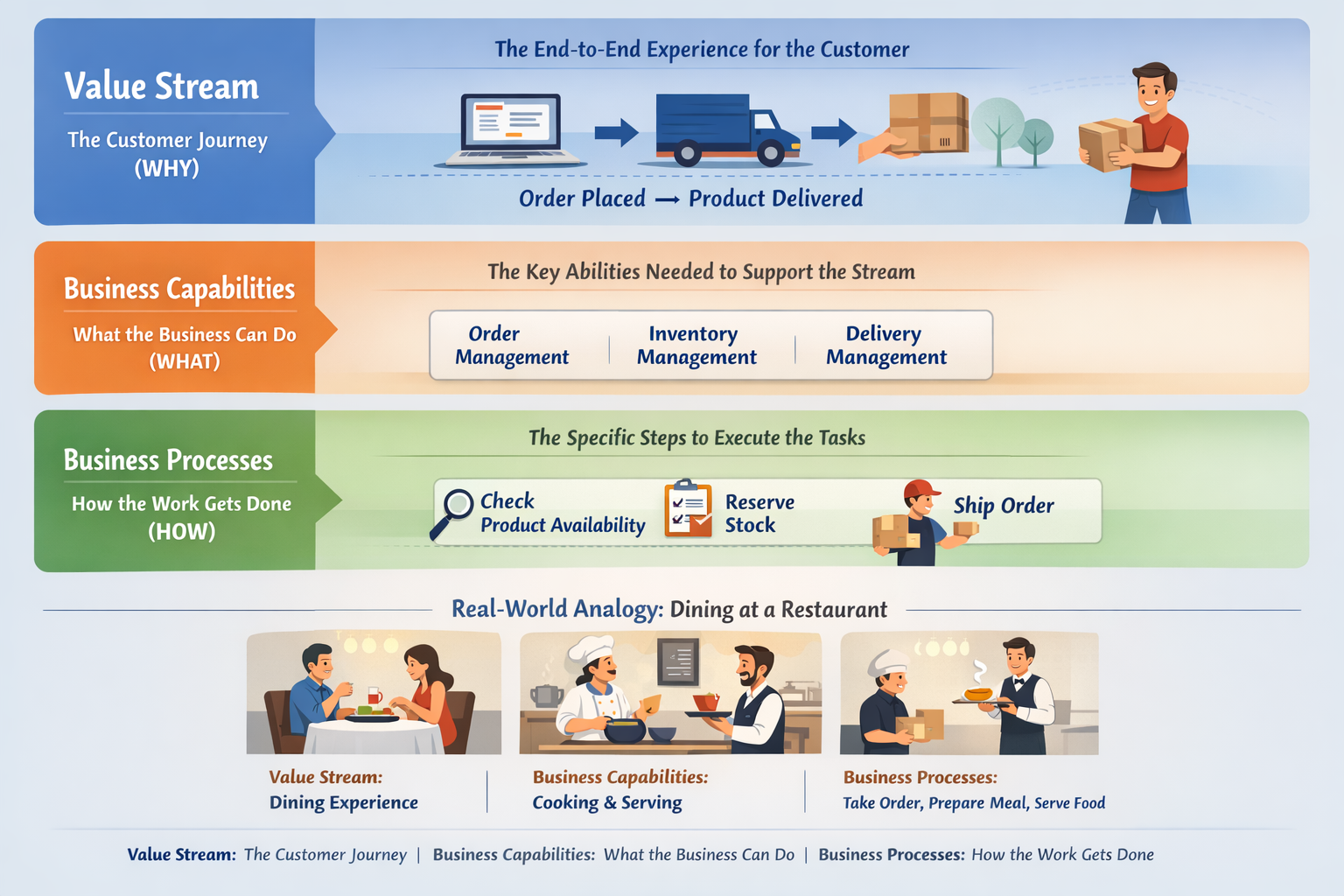
Imagine you’re sitting in a business meeting. Someone stands up and starts talking about “value streams,” “business capabilities,” and “business processes.” Everyone nods. You nod too. But inside, you’re not entirely sure what any of it actually means , and you suspect a few other people in that room feel exactly the same way.
Every time you’ve ordered food on your phone and waited for it to arrive at your door, every time you’ve walked into a restaurant and sat down for a meal , you’ve experienced “value streams,” “business capabilities,” and “business processes.” without knowingly. Nobody explained it to you in business language, but it was all there. All we need to do now is give it a name.
Let’s start with the biggest of the three ideas: the value stream. Picture a river. It starts somewhere high up in the mountains , a tiny trickle of snowmelt and it flows all the way down through valleys and towns until it reaches the ocean. Along the way it changes shape, it picks up pace, it passes through different landscapes. But it’s always the same river, and it always has one destination. A value stream works the same way. It is the complete, end-to-end journey that takes a customer from the moment they have a need all the way to the moment that need is fulfilled. It doesn’t belong to one team or one department. It flows across the whole organisation, just like that river flows across the whole landscape.
Let’s bring it to life. You’re at home, it’s a Friday evening, and you’re hungry. You open a food delivery app, scroll through the options, find your favourite burger place, and tap Order. Forty minutes later, someone knocks on your door and hands you a warm bag of food. That entire experience , from the moment you felt hungry to the moment you took your first bite is a value stream. It crossed your phone, the restaurant’s kitchen, a driver on a motorbike, and a payment system. Many different people and technologies were involved. But from your perspective as the customer, it was one seamless flow of value being delivered to you.
Now picture a different Friday evening. Instead of ordering in, you decide to go out. You walk into a restaurant, you’re greeted and shown to your table, a server takes your order, the kitchen gets to work, your food arrives, you eat, you pay, and you leave feeling satisfied. That is also a value stream , different in its details, but identical in its structure. A need existed. Steps were taken. The need was met.
The most important thing to understand about a value stream is that it is always told from the customer’s perspective. It starts with what the customer wants and ends with the customer getting it. Everything in between is part of the stream. And any step in between that doesn’t move the customer closer to getting what they came for? That’s waste , and smart organisations spend a lot of energy finding and removing it.
Now let’s zoom in one level. We know what the full journey looks like. But what does the business actually need in order to make that journey possible? That’s where capabilities come in. Think about a person who is highly skilled. Maybe they can drive a car, speak two languages, cook well, and manage their finances carefully. These aren’t tasks they’re doing right now - they’re abilities they possess. They could use them today, tomorrow, or next year. Their circumstances might change, the tools they use might change, but the underlying abilities remain. Those are capabilities.
A business has capabilities in the same way. A capability is something the organisation must be able to do in order to deliver value to its customers. And here is the crucial point, a capability describes what the business needs to do, not how it does it. Take the food delivery company. For it to get your burger from the restaurant to your door, it needs to be able to manage orders, process payments, dispatch drivers efficiently, communicate with customers, and coordinate with restaurant partners. Each of those is a capability. The company must possess each of those abilities, or the value stream breaks down. Now take the sit-down restaurant. It needs to be able to manage reservations, prepare food to a consistent standard, serve customers attentively, manage its menu, and handle billing. Again, each of those is a capability. Some of them overlap with the delivery company’s capabilities. Both businesses, for instance, need to be able to prepare food and handle payment. The capability is the same. How they do it might look completely different.
And that last point is what makes capabilities so powerful as a planning tool. Because technology changes. People come and go. Regulations shift. The way you do something today might be completely different in five years. But the thing you need to be able to do, that stays remarkably stable. A restaurant will always need the ability to prepare food. It might one day use robotic kitchens or AI-assisted cooking. The process will have changed beyond recognition. But the capability, food preparation, remains constant.This is why executives and planners think in terms of capabilities. It lets them invest, build, and plan for the long term without locking themselves into any one way of doing things.
We’ve seen the full journey. We’ve identified the abilities the business needs to make it happen. Now we get to the most detailed level of all, how exactly does each of those abilities get carried out, day after day, by real people and real systems? That is a business process. A business process is a specific, documented, repeatable sequence of steps. It takes a capability and turns it into action. If a capability is the skill, the process is the technique.
Think about the food delivery company’s Order Management capability. One of the processes that brings that capability to life is the order-taking process. A customer opens the app. They browse the menu and add items to their cart. They enter their delivery address and confirm payment. The system automatically checks that the items are available and that the order is valid. The order is then sent to the restaurant’s screen. A member of staff at the restaurant acknowledges the order and begins preparation. The customer receives an automatic confirmation on their phone. That is a business process, a specific, step-by-step sequence that happens the same way every single time an order is placed. Now picture the restaurant’s Table Service capability. The process for seating a guest goes something like this. A guest walks through the door. The host greets them warmly and asks whether they have a reservation. They check the booking system. If there’s a reservation, the guest is led to their table. If it’s a walk-in, the host checks what’s available. Menus are provided, the server is introduced, and the table is handed over. From that point, the server greets the guests and takes a drinks order. Every single guest who walks through that door goes through this same sequence. It doesn’t change based on who’s working or how busy the restaurant is. That consistency is the whole point. Processes exist because without them, organisations become unpredictable. If every server at a restaurant handled a new guest differently , some offering menus immediately, some forgetting to introduce themselves, some checking for reservations and some not, the experience would be chaotic and inconsistent. Customers would never quite know what to expect. Quality would vary wildly. And when something went wrong, nobody would know where to look to fix it. A well-designed process removes that chaos. It ensures that the same good outcome is produced reliably, every time, regardless of who is doing the work.
The value stream is the widest view. It shows you the full customer journey from need to fulfilment, and it forces you to ask whether every step along the way is actually adding value. The capability is the mid-level view. It identifies the specific abilities the organisation must possess to make that journey possible, without yet prescribing how those abilities are exercised. The process is the ground-level view. It gets into the detail of exactly who does what, in what order, using which systems.
Going back to our delivery example, the value stream is “hungry customer gets their meal delivered.” To make that happen, the business needs capabilities like order management, payment processing, driver dispatch, and customer communication. And within the order management capability alone, there are multiple processes: the process for taking an order, the process for modifying or cancelling one, the process for tracking delivery in real time, and the process for confirming delivery to the customer.
It’s like a Russian nesting doll. The value stream is the outer layer, the big picture. Open it up and you find the capabilities inside. Open each capability and you find the processes. Each layer is complete in itself, but they only make full sense when you see how they nest together.
You might reasonably ask, why bother distinguishing between them at all? Why not just document your processes and get on with it? The answer is that each of the three concepts solves a different problem, and no single one of them can do the job of the others. Without value streams, organisations become inward-looking. Teams focus on their own patch of the business and lose sight of the customer. A restaurant kitchen might pride itself on turning out dishes in eight minutes, but if the front-of-house team is slow and disorganised, the customer still waits half an hour and leaves unhappy. The kitchen optimised its corner. Nobody looked at the full stream. Without capabilities, organisations get lost in short-term thinking. Every time the technology changes or a key person leaves, they feel like they’re starting from scratch. By thinking in capabilities, a business understands what it fundamentally needs to be able to do, and can make long-term investments in people, systems, and knowledge that survive any single change in the way things are done. And without processes, organisations are simply inconsistent. Good outcomes happen sometimes, for some customers, with some members of staff. But they can’t be relied upon. Processes are what turn a good idea into a reliable, repeatable reality.
Conclusion Value streams, business capabilities, and business processes are not three separate, complicated ideas invented by consultants to fill up slide decks. They are three natural ways of looking at the same business, each giving you a different but equally important perspective. The value stream asks: what is the journey we are taking our customer on? The capability asks: what do we need to be able to do to make that journey possible? And the process asks: how exactly are we going to do it? Every time you order food and it arrives at your door, all three of these are working quietly in the background. Every time you sit down at a restaurant and leave feeling well looked after, the same is true. These ideas aren’t abstract, they are the invisible architecture behind every experience you’ve ever had as a customer. And now that you can see them, you’ll never stop seeing them.